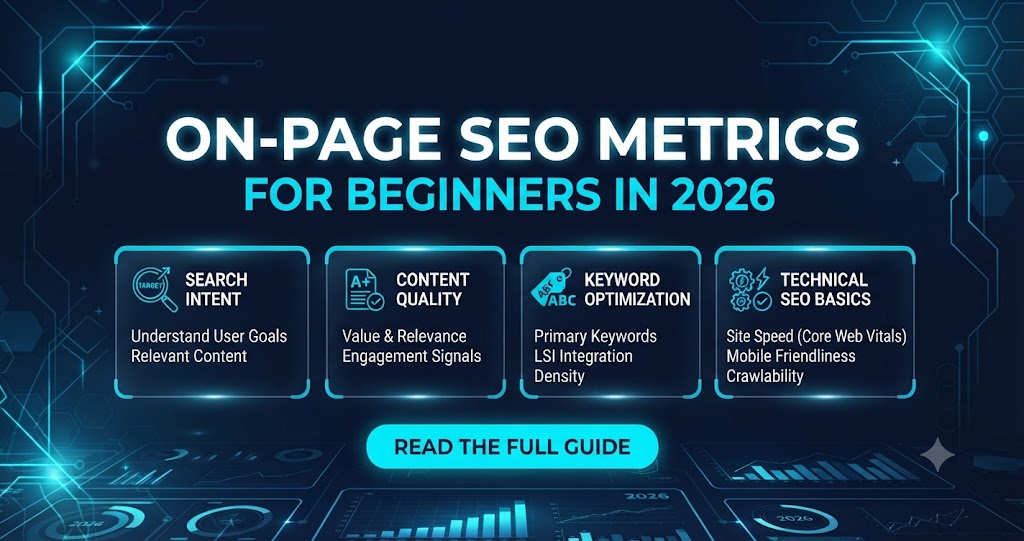
On-Page SEO Metrics for Beginners: The Complete Guide to Ranking Smarter in 2026
Search engines no longer rank websites simply because they contain keywords. In 2026, Google evaluates quality, relevance, user experience, topical authority, and content structure before deciding whether your page deserves a top position—or even an AI Overview citation.
If you’re new to SEO, understanding on-page SEO metrics is one of the fastest ways to improve rankings without spending money on advertisements.
This guide explains every important on-page SEO metric using practical examples, comparison tables, AI optimization tips, recommended tools, and beginner-friendly explanations.
What Are On-Page SEO Metrics?
On-page SEO metrics are measurable signals that indicate how well a webpage is optimized for search engines and users.
These metrics help search engines understand:
- What your page is about
- Whether your content satisfies search intent
- How trustworthy your information is
- Whether users enjoy reading your page
- If your content deserves to rank higher
Think of on-page SEO as preparing your website for both Google Search and AI-powered search experiences.
Why On-Page SEO Matters More in 2026
The rise of AI-powered search has changed SEO forever.
Today’s search engines don’t simply find matching keywords—they understand context, relationships between topics, and user intent.
Modern search results may include:
- AI Overviews
- Featured Snippets
- People Also Ask
- Knowledge Panels
- Video snippets
- Image packs
- Local results
Proper on-page optimization increases the chances of appearing in these rich search features.
How AI Overviews Use Your Content
Google’s AI doesn’t copy entire articles.
Instead, it looks for small, highly reliable pieces of information that answer specific questions.
For example:
Question
What is title tag optimization?
A well-written page might contain:
A title tag is an HTML element that tells search engines and users what a webpage is about. Keeping it between 50–60 characters improves visibility in search results.
Because this answer is:
- concise
- factual
- easy to understand
- well structured
Google can easily reference it inside AI Overviews.
AI-Friendly Content Characteristics
- Short paragraphs
- Direct answers
- Clear headings
- Lists
- Tables
- Definitions
- Statistics
- Examples
- FAQ sections
- Schema markup
These elements help AI identify trustworthy information quickly.
The Most Important On-Page SEO Metrics
1. Title Tag
The title tag is usually the first thing users see in Google.
Good title:
On-Page SEO Metrics for Beginners (2026 Guide)
Poor title:
Home
Best Practices
- 50–60 characters
- Primary keyword near the beginning
- Include the year when relevant
- Make it compelling
2. Meta Description
Although meta descriptions aren’t a direct ranking factor, they influence click-through rate (CTR).
Good example:
Learn the essential on-page SEO metrics, AI optimization tips, tools, examples, and ranking strategies for beginners in 2026.
Ideal length:
- 140–160 characters
3. URL Structure
Good URL
example.com/on-page-seo-metrics
Bad URL
example.com/post?id=76281&page=22
Use:
- lowercase
- hyphens
- descriptive words
- short URLs
4. Heading Structure (H1–H6)
A logical heading hierarchy helps both readers and search engines.
Example:
H1
Complete Guide to On-Page SEO Metrics
H2
What is On-Page SEO?
H3
Title Tags
H3
Meta Descriptions
H2
SEO Tools
Never skip from H2 directly to H5 without reason.
5. Keyword Placement
Instead of repeating one keyword excessively, naturally include:
- Primary keyword
- Secondary keywords
- Related phrases
- Semantic keywords
Example:
Primary:
On-page SEO metrics
Secondary:
- SEO metrics
- On-page optimization
- Technical SEO basics
- Google ranking factors
- AI SEO
6. Content Quality
Google rewards pages that are:
- Original
- Helpful
- Accurate
- Updated
- Comprehensive
A 1,000-word article with genuine expertise often performs better than a 3,000-word article filled with unnecessary repetition.
7. Search Intent Match
Always ask:
“What does the searcher actually want?”
Example
Keyword:
Best SEO tools
The searcher expects:
- comparisons
- pricing
- pros
- cons
Not the history of SEO.
Matching intent is often more important than keyword density.
8. Internal Linking
Internal links help distribute authority across your website.
Example
Blog:
Technical SEO Checklist
Links to:
- XML Sitemap Guide
- Robots.txt Guide
- Keyword Research Guide
Benefits:
- Better crawling
- Longer sessions
- Improved topical authority
9. Image Optimization
Every image should include:
- descriptive filename
- alt text
- compressed size
- modern format (WebP)
Example
Filename:
on-page-seo-metrics-dashboard.webp
Alt text:
Dashboard showing key on-page SEO performance metrics
10. Readability Score
Content should be easy to scan.
Use:
- short paragraphs
- bullet points
- numbered lists
- whitespace
- examples
A page that is easier to read usually keeps users engaged for longer.
11. Core Web Vitals
Page experience is still important.
Monitor:
- Largest Contentful Paint (LCP)
- Interaction to Next Paint (INP)
- Cumulative Layout Shift (CLS)
Fast websites improve user satisfaction and support stronger SEO performance.
12. Schema Markup
Schema helps search engines understand page content.
Common schema types include:
- Article
- FAQ
- Breadcrumb
- Product
- Local Business
- Organization
- HowTo
Proper schema can improve eligibility for rich results.
On-Page SEO Metrics Comparison Table
| Metric | Why It Matters | Ideal Target |
|---|---|---|
| Title Tag | Improves relevance and CTR | 50–60 characters |
| Meta Description | Encourages clicks | 140–160 characters |
| URL | Better readability | Short and descriptive |
| H1 | Defines page topic | One H1 per page |
| Internal Links | Pass authority | 3–10 relevant links |
| Images | Accessibility and SEO | Optimized with alt text |
| Content Length | Covers topics thoroughly | Based on search intent |
| Core Web Vitals | User experience | Pass Google’s thresholds |
| Schema | Rich results eligibility | Valid structured data |
| Readability | User engagement | Simple, scannable content |
Best SEO Tools for Measuring On-Page Metrics
| Tool | Best For | Free Version |
|---|---|---|
| Google Search Console | Indexing, clicks, impressions | ✅ |
| Google Analytics 4 | User behavior | ✅ |
| Screaming Frog SEO Spider | Site audits | ✅ Limited |
| Ahrefs | Backlink and content analysis | ❌ |
| SEMrush | Keyword and on-page audits | ❌ |
| Surfer SEO | Content optimization | ❌ |
| PageSpeed Insights | Core Web Vitals | ✅ |
| Rich Results Test | Schema validation | ✅ |
| Yoast SEO | WordPress optimization | ✅ |
| Rank Math | On-page SEO | ✅ |
AI and On-Page SEO: How They Are Connected
AI-powered search systems evaluate more than keywords. They analyze:
- Context
- Relationships between topics
- Entity recognition
- User intent
- Content freshness
- Trust signals
- Structured data
- Readability
To improve visibility in AI-generated search experiences:
- Answer questions directly.
- Use descriptive headings.
- Add comparison tables.
- Include FAQs.
- Cite trustworthy sources where appropriate.
- Keep information up to date.
- Structure content logically.
- Implement schema markup.
Think of your article as a well-organized knowledge resource rather than just a collection of keywords.
Example of AI-Friendly Content
Instead of writing:
SEO is important because SEO helps websites rank. SEO ranking depends on SEO optimization and SEO keywords.
Write:
On-page SEO helps search engines understand your content through optimized titles, headings, internal links, and structured information. When these elements align with user intent, your pages are more likely to rank well and appear in AI-generated search results.
The second version is clearer, more natural, and more useful to both readers and AI systems.
Beginner’s On-Page SEO Checklist
Before publishing any page, make sure you have:
- ✔ One clear H1
- ✔ Optimized title tag
- ✔ Compelling meta description
- ✔ Clean URL
- ✔ Primary keyword in key locations
- ✔ Helpful, original content
- ✔ Internal links
- ✔ Optimized images with alt text
- ✔ Mobile-friendly design
- ✔ Fast loading speed
- ✔ Valid schema markup
- ✔ FAQ section
- ✔ Up-to-date information
Common On-Page SEO Mistakes
Avoid these frequent errors:
- Keyword stuffing
- Duplicate title tags
- Multiple H1 headings
- Thin or low-value content
- Missing alt text
- Broken internal links
- Slow-loading pages
- Ignoring search intent
- Outdated information
- Publishing without structured data
Frequently Asked Questions
What is the most important on-page SEO metric?
There isn’t a single metric that guarantees rankings. High-quality content, search intent alignment, title tags, heading structure, internal linking, and page experience work together to improve visibility.
How often should I update on-page SEO?
Review important pages every 6–12 months, or sooner if search trends, user behavior, or your industry changes.
Can AI-generated content rank on Google?
Yes, provided it is accurate, original, helpful, and demonstrates expertise. AI-assisted content should be reviewed, expanded with unique insights, and optimized for user value rather than published without oversight.
Which free tool is best for beginners?
Google Search Console is an excellent starting point. It provides insights into search performance, indexing, clicks, impressions, and technical issues directly from Google.
Does schema markup improve rankings?
Schema markup is not a direct ranking factor, but it helps search engines understand your content and can make your pages eligible for rich results, improving visibility and click-through rates.
Final Thoughts
On-page SEO in 2026 is about creating content that is easy for both people and AI systems to understand. Instead of chasing keyword density, focus on clear structure, helpful answers, strong user experience, and well-organized information.
By optimizing elements such as title tags, headings, URLs, internal links, images, Core Web Vitals, and structured data, you build pages that are more likely to rank in traditional search results while also being considered for AI Overviews and other rich search features. Consistently applying these best practices will help you improve visibility, attract qualified organic traffic, and build lasting authority in your niche.